
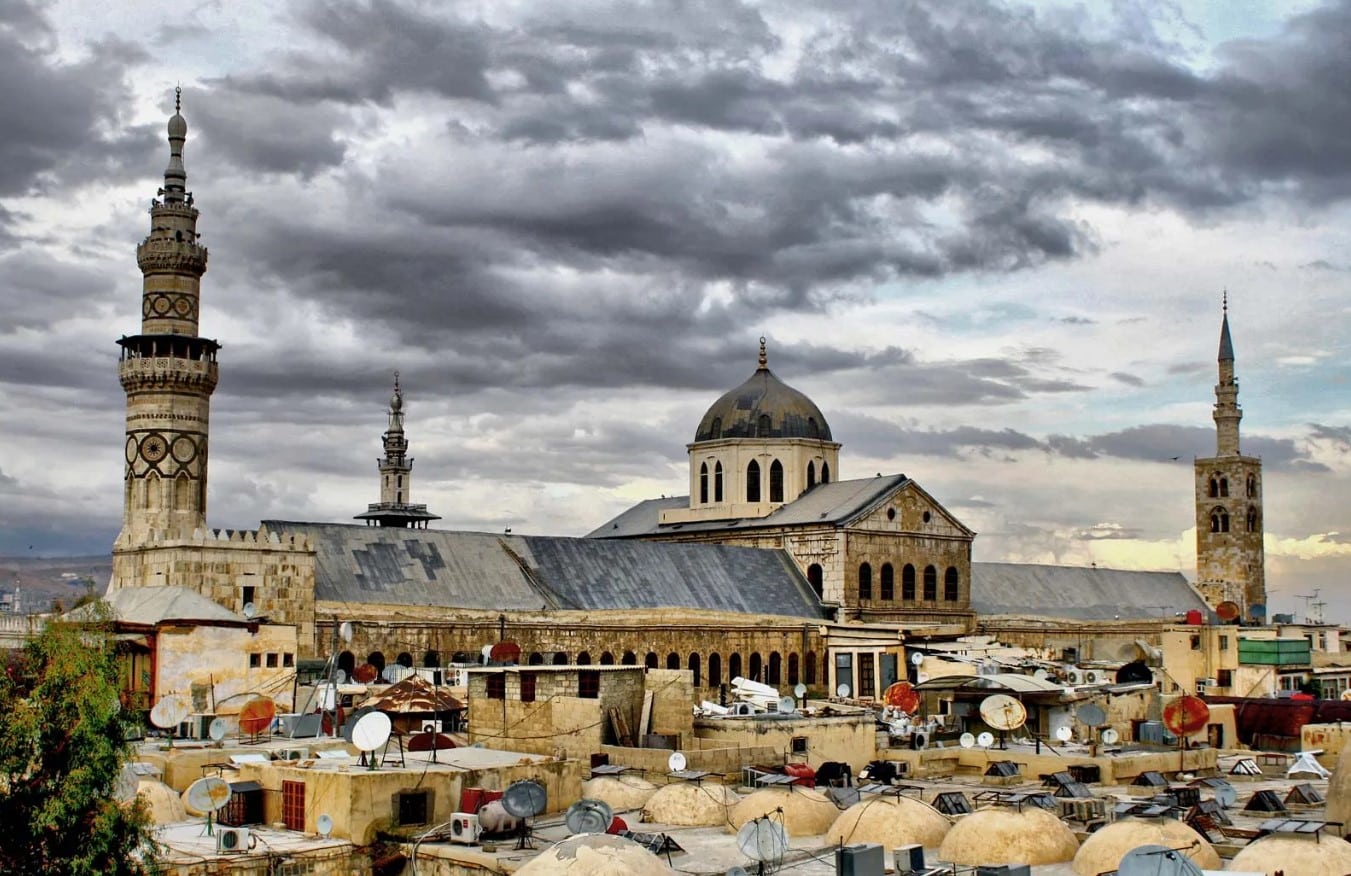
Weekly Incident Map
Dear subscriber. Welcome to the Syria Weekly Report – a brand-new reporting service launched by Talos that provides high-quality information and analysis on Syria. The report is focused on broader strategic and political developments in the country, as well as Syria’s relations to regional stakeholders and surrounding countries. The report is disseminated every Tuesday and is complemented by a daily report.
The service will be provided for our existing subscribers for free for a limited time period and then offered as a separate, stand-alone product outside your regular subscription. For inquiries regarding prices for a subscription, or the availability of bespoke reporting on Syria – including in-depth reports, risk assessments and incident data – please email [email protected]. Please also contact us if you are interested in transportation or other security services in Syria. In the meantime, please enjoy this complimentary service.
Executive Summary
-
Foreign Minister Al-Shaibani attended Davos Summit
-
EU agree to roadmap for sanctions relief
-
Saudi Arabia leads GCC support for new government
-
HTS-led security operations continue against resistance factions
-
SDF and Arab tribal factions clashed in the east amidst integration efforts
Foreign Minister Al-Shaibani attended Davos Summit
The Syrian government led by Tahrir al-Sham (HTS) continued to engage with international stakeholders this week in a bid to promote its image as a moderate, progressive government and to encourage international investment and support. Like previous weeks, related rhetoric focused largely on the issue of sanctions relief as the European Union (EU) moves closer to lifting sanctions imposed during the Assad regime. In a symbolically significant development, Foreign Minister Assad al-Shaibani attended the World Economic Forum in Davos for the first time and in his remarks the official predictably stressed the importance of lifting sanctions to facilitate investments and alleviate humanitarian conditions. Al-Shaibani also portrayed Syria as an investment opportunity, by citing the need for upgrading the national infrastructure and called on foreign stakeholders to invest in the country. The remarks followed comments by Saudi Foreign Minister Prince Faisal bin Farhan who also attended the forum and who likewise urged Western leaders to lift sanctions in order to support the Syrian people.
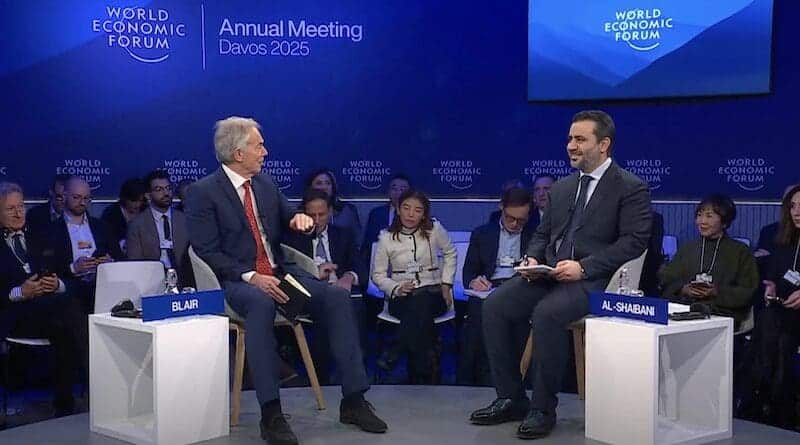
Former UK Prime Minister Tony Blair and Foreign Minister Assad al-Shaibani in Davos
While not resulting in any significant new statements or concrete results, Al-Shaibani’s attendance at the forum constitutes in itself a political victory for the new government in its bid to shore up its international legitimacy and engage with the West.
EU agree to roadmap for sanctions relief
Notably, Al-Shaibani’s appearance took place only days prior to a meeting between EU officials in Brussels to discuss the issue of lifting sanctions and the remarks made in Davos were clearly intended as a diplomatic charm offensive ahead of the meeting on 27 January. In the meeting, the Foreign Ministers of the EU member states agreed on a “roadmap” to gradually lift sanctions and EU Foreign Policy chief Kaja Kallas said a “political agreement” was reached to lift measures that are “most hindering the early buildup of the country and to move from there.” Kallas further reiterated that easing sanctions would help the “Syrian economy and help the country get back on its feet” but that the ministers also agreed on retaining “snap back” mechanisms in the event of human rights violations and other wrong steps being taken by the new government.
The roadmap agreed to on 27 January was largely expected as EU officials have repeatedly expressed support for sanctions relief, but only on the condition that the new government remains committed to an inclusive political transition and respect for human rights. A step-by-step approach that allows the bloc to quickly reimpose sanctions is therefore the most likely way forward and the EU is expected to continue conditioning any practical measures to lift sanctions on the government’s demonstrated ability to fulfill what it says in practice. It is worth noting that the outcome of the 27 January only amounts to a political agreement and not a deal to ease measures immediately. In her remarks, Kallas emphasized that there are also technical issues that need to be resolved before any restrictions can be lifted. Regardless, the meeting is a significant step forward and is set to pave the way for more concrete negotiations on which sanctions to lift over the coming weeks.
Saudi Arabia leads GCC support for new government
The Saudi Foreign Minister’s remarks at Davos were also significant in the context of his subsequent visit to Syria which, combined with public calls for sanctions relief and an increase in humanitarian aid, underscore Riyadh’s increasingly close engagement with the HTS-led government. Later in the week, Farhan arrived in Damascus on his first visit to the country since the fall of the Assad-led government, with subsequent meetings also emphasizing Saudi Arabia’s commitment to supporting and praising the steps taken by the new government. In the following days, fifty-four aid delivery trucks dispatched by Riyadh crossed the Saudi-Jordanian border, destined for Syria, while several Saudi aid delivery planes loaded with food, shelter and medicine also arrived in Damascus during the week. This follows an easing of US restrictions earlier this month that now allows several countries, including Saudi Arabia, to shore up humanitarian aid.
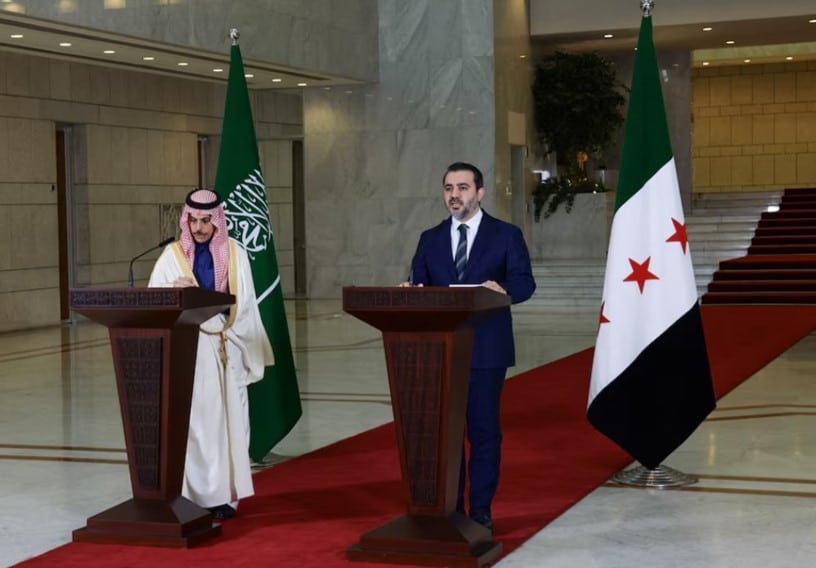
Saudi Foreign Minister Prince Faisal bin Farhan and counterpart Al-Shaibani
As previously discussed, Saudi Arabia’s positioning as a key backer of the new government is assessed to serve various geopolitical and economic interests which set conditions for continued Saudi support over the coming months. One is to position Saudi companies and stakeholders favorably for any future investment opportunities, with a lifting of sanctions set to open up a new market for Saudi investors. A related objective is to promote Saudi Arabia’s image as a provider of humanitarian support both inside Syria – and in a manner that allows close engagement with local stakeholders in HTS-controlled areas – but also internationally. On a geopolitical level, this is also assessed to at least partially block possible Iranian influence, with support for the HTS set to consolidate Iran’s exclusion from the country following the fall of President Assad. This last objective is at least nominally set to increase possible Israeli-Saudi-US collaboration, with both Israel and the US likely to favor and encourage continued Saudi engagement in Syria – a consideration that may also encourage the US to eventually lift sanctions.
Despite this, Saudi’s support for the new government is not unproblematic within the Gulf Cooperation Council (GCC) where some members approach the new government with a degree of caution. Both Bahrain and the UAE – while supportive of the government change and Iran’s declining influence – have adopted a more pragmatic and possibly skeptical approach to the HTS, given its long-standing opposition to Islamist factions and counter-revolutionary foreign policy that has generally favored stability over upheavals. Despite initially supporting the Free Syrian Army and other elements of the opposition, the UAE gradually came to normalize ties with Assad and continues to view Islamist movements born out of the Arab Spring as an existential threat to regional stability. So far, the UAE and Bahrain have supported the GCC’s engagement with the new government, and are likely to support Syria’s return to the Arab League, however both sides will likely proceed to engage the HTS with a much higher level of caution than Saudi Arabia.
HTS-led security operations continue against resistance factions
The situation within HTS-controlled areas remains relatively stable and the level of daily hostilities remains minor in comparison to the more unstable frontline areas in the northeast. Parallel to efforts to shore up its international legitimacy, the HTS’ domestic agenda remains focused on integrating armed factions into a new military command structure, and under a new Syrian regular army. So far, these efforts remain largely successful, with the Syrian Democratic Forces (SDF) remaining the key obstacle (see below).
That said, acts of resistance against the HTS continue to be reported in the central provinces of Latakia, Hama, and Homs, with the majority including isolated attacks targeting checkpoints and stationed HTS personnel. Several incidents and engagements were also reported this week during routine security operations conducted within government-controlled areas, as pockets of former regime-supporting and other militia elements resist HTS-led law enforcement efforts. The so-called Syrian Resistance – an opposition group assessed to comprise former regime sympathizers who declared a campaign of armed resistance in December – also claimed responsibility for various minor security incidents targeting HTS elements in Latakia, Hama and Tartous provinces. The majority of these alleged attacks were minor and not verified by other sources, with future claims by the group to be taken with a degree of caution.
In a potentially more disconcerting development, reports of abuses, extrajudicial killings and excessive violence were also reported this week within areas dominated by Alawite and Shia residents. Notably, between 21 and 23 January, multiple sources detailed acts of excessive violence during HTS-led security operations that included reports of executions targeting Alawite residents. These operations were reported in areas associated with resistance factions and follow the previously discussed increase in attacks against the HTS earlier this month, with the activity this week likely comprising an HTS-led counter-response. The Syrian Observatory of Human Rights and other sources also documented cases of civilian “displacements” in areas near the Lebanese border, with localized tensions increasing as a result.
It should be noted that much of this reporting is limited to politicized sources and may be partially attributed to information efforts led by opposition factions to delegitimize the HTS, especially amidst current efforts to ensure sanctions relief. It is also unclear to what extent these activities are condoned by the senior leaders, as opposed to attributed to local elements operating outside the formal chain of command. Regardless, these developments are a cause of concern and are set to raise questions by foreign stakeholders should they continue. This week, the Iranian Foreign Minister expressed concerns about these activities and called on the government to ensure the protection of Alawite and Shia minority rights. For Iran, these reports – regardless of their veracity and credibility – certainly entail an opportunity to delegitimize the HTS and undermine its efforts to engage with the West.
SDF and Arab tribal factions clashed in the east amidst integration efforts
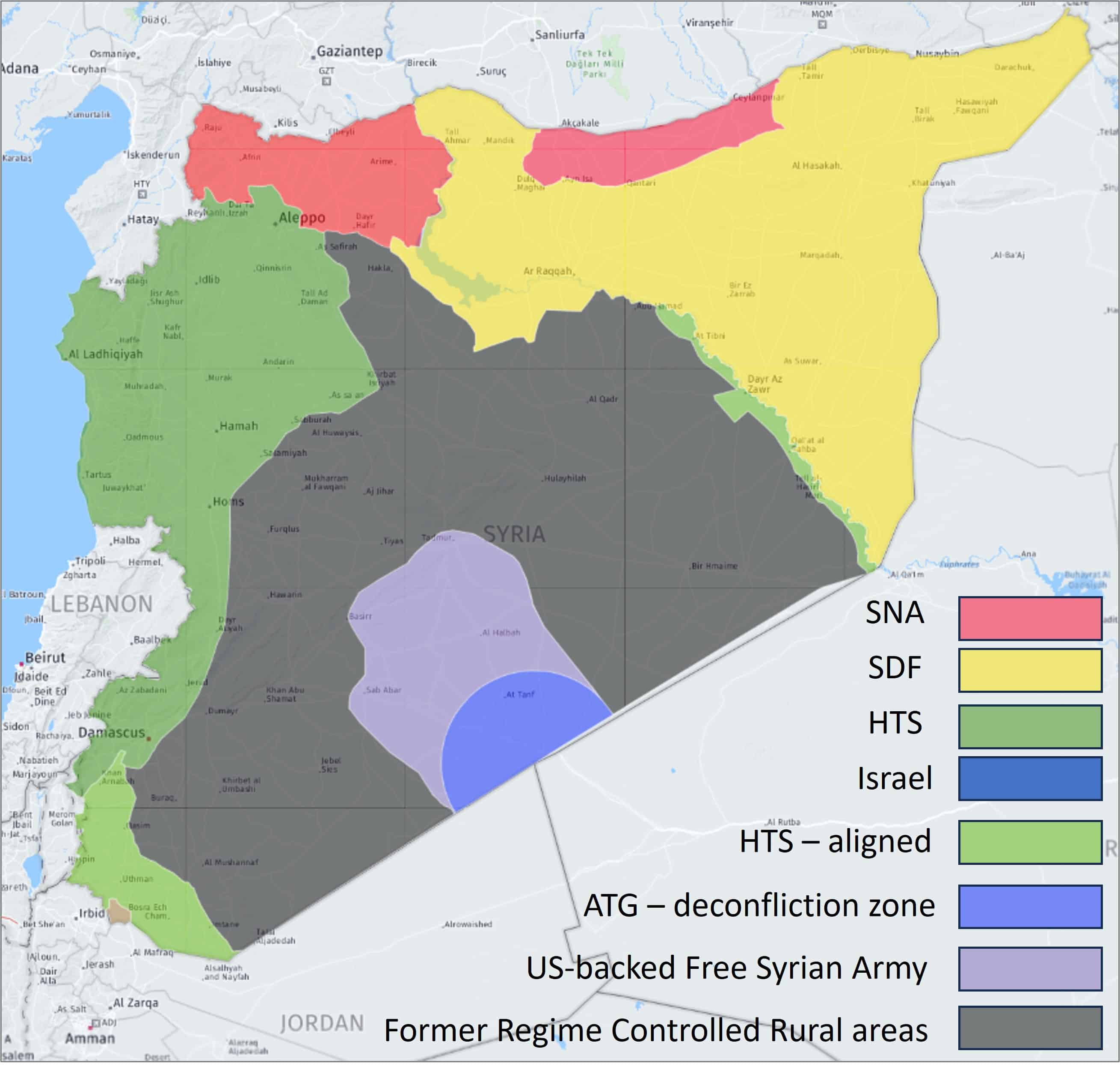
The situation in the north and eastern areas of the country remains volatile amidst Turkish-backed efforts to dislodge the SDF and parallel, related attempts by the HTS to integrate the SDF into the new military structure. This week, the SDF continued to reject efforts by the HTS to become part of a new, unified command structure by insisting that integration would only be accepted if the SDF retains its composition as a separate “bloc”. This would ensure that the group retains a degree of autonomy and independence, and be consistent with the SDF’s broader vision of a decentralized Syrian constitution that preserves a high level of regional autonomy for its subjects.
This demand has been rejected by the HTS which continues to insist that the SDF is integrated on an individual basis. The HTS’s political efforts remain characterized by a combination of soft power and hard demands, with Foreign Minister Assad al-Shaibani this week releasing a number of statements that seemed aimed to appeal to the Kurdish population. In a post on social media platform X, Al-Shaibani – writing in Kurdish for the first time – said the Kurds add “beauty and brilliance” to Syria while deploring the manner in which they had been wronged by the previous government. In a separate statement released the same day however, Defence Minister struck a very different tone when he suggested the HTS may use military force against the SDF unless they continue to refuse demands for integration.
Meanwhile, tensions on the ground escalated this week between the two sides in the northeastern areas as the HTS reportedly deployed elements towards the frontlines in Deir Ez Zour and Aleppo province – a move likely coordinated with the Turkish-backed Syrian National Army to put pressure on the SDF. Meanwhile, Arab tribal forces based on the western side of the Euphrates crossed the river between 19 and 21 January and launched coordinated assaults against six villages and towns east of the river. The forces managed to take temporary control over several villages as a result. Later reports stated that SDF control was restored following the arrival of military reinforcements in all areas, but only following lengthy clashes that killed at least five SDF members. The SDF also proceeded to impose a curfew and informed residents that any violations of the curfew and “illegal movements” would be treated as a hostile action.
In a later statement, the SDF blamed “groups linked to the former Baathist regime and the National Defence Militia” (a pro-Assad militia) for attempting to destabilize the situation in Deir Ez Zour. The SDF vowed to confront such attempts and said it would conduct security operations targeting remnants of the Baathist regime near the Euphrates River, in collaboration with international coalition forces, to prevent the resurgence of IS cells. The situation in the affected areas has since stabilized however local reports of engagements and fire exchanges between the SDF, local tribal elements and the HTS continue to be reported, with the situation remaining volatile and subject to rapid changes overall.
Control of Terrain Map – 28 January 2025
 and then