
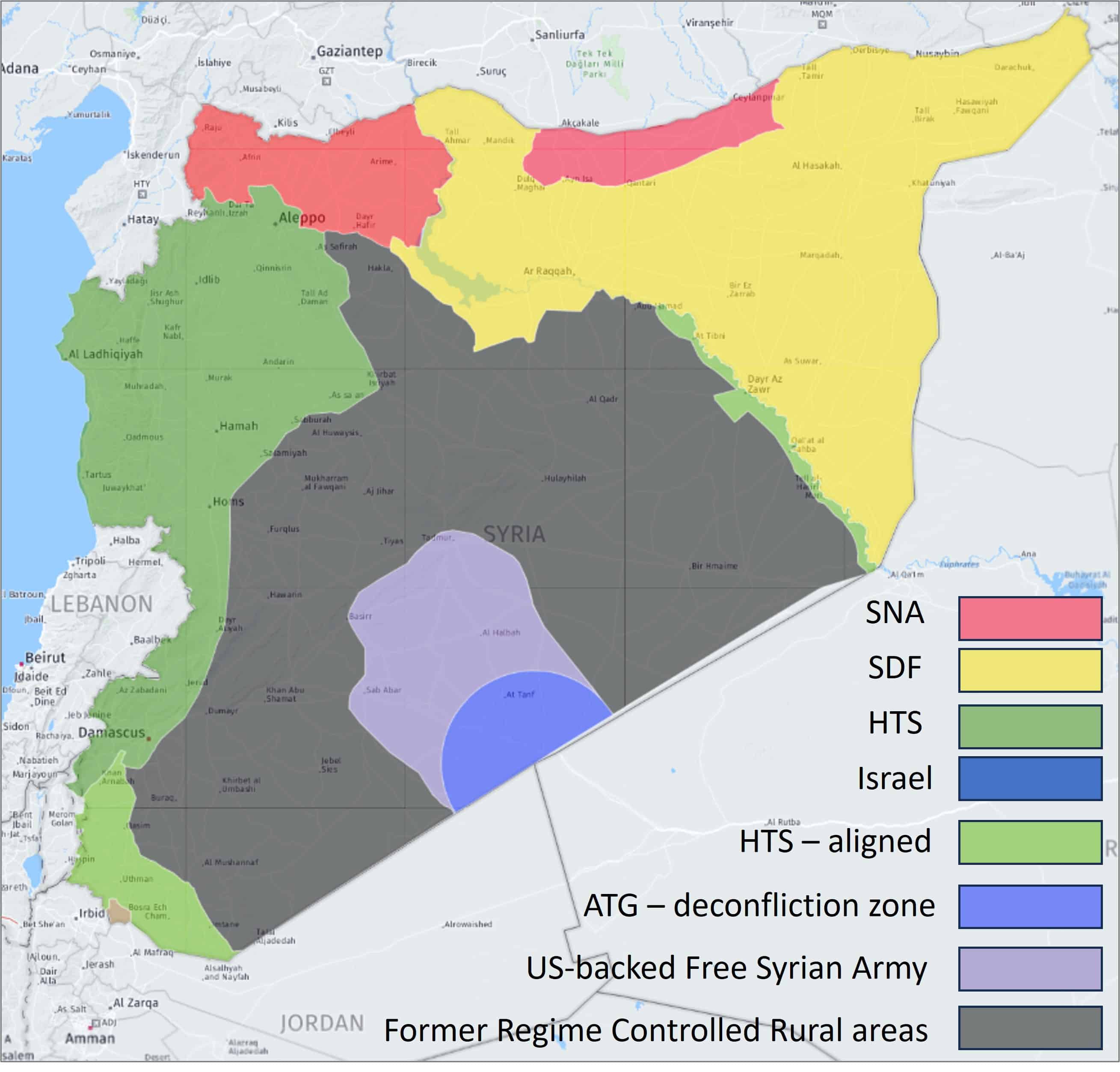
NATIONAL OVERVIEW
Nationwide incidents
SIGNIFICANT EVENTS
- Ahmed al-Sharaa named President of Syria
- Qatar welcomes announcement ahead of Emir visit
- Huras al-Din announce dissolution in Syria
- Reports of VBIED detonation in Damascus dismissed as false reporting
- Conflicting reports of shooting near Russian Embassy
- Celebratory fire in Damascus following ‘Victory’ conference
- Israeli forces enter western Daraa countryside
- Attempted assassination of former regime-linked individual in Daraa
- Turkish airstrikes continue in eastern and northern Aleppo
- Hostilities between SDF and SNA continued in Hasaka province
- Security operations and remnant explosions in Deir Ez Zour
- Threats of retaliatory events in Homs province
- Grenade attack and security operation reported in Latakia and Idlib
STRATEGIC AND POLITICAL DEVELOPMENTS
Ahmed Sharaa named President of Syria
On 29 January, the spokesperson for the HTS-led Military Operations Administration announced the appointment of Ahmed al-Sharaa – the leader of HTS and the interim government – as President of Syria. Hassan Abdul Ghani said al-Sharaa will assume the presidency position during the transitional phase and represent Syria in “international forums.” The announcement came during a conference organized by the senior HTS leadership in Damascus named the “Victory Conference” during which several other major announcements were made including:
- The dissolution of the People’s Assembly and the formation of a temporary legislative council for the remainder of the transition period;
- The suspension of the 2012 constitution and associated emergency laws;
- The abolition of the Baath Party as well as the National Progressive Front and other organizations, institutions, and committees affiliated with the former regime;
- The dissolution of the previous Syrian army, all affiliated militia groups and security agencies, and a pledge to rebuild a new national army on “national grounds;
- The dissolution of all military factions and “revolutionary bodies”, and their integration in state institutions.
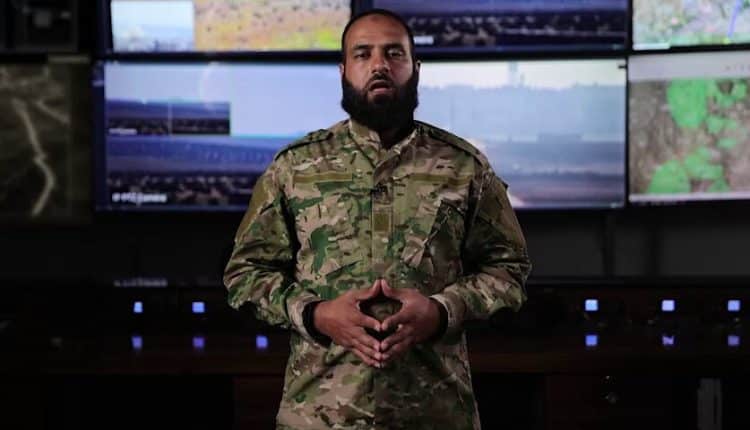
HTS Spokesperson Hassan Abdul Ghani
In a speech that was not broadcast live but cited by the official Syrian News Agency (SANA), al-Sharaa stressed the importance of building a new Syria and outlined a list of priorities for the interim government. These include the need to fill power vacuums, preserve “civil peace”, rebuild state institutions and improve the national economy.
Qatar welcomes announcement ahead of Emir visit
Qatar was the first country to welcome the appointment of al-Sharaa as the new president and, in a statement, the Ministry of Foreign Affairs stressed the importance of forming a single army representing “all components without exclusion” and with the capacity to exercise a monopoly of force within Syria. The statement also reiterated Qatar’s support for Syria in “all fields” and its “contribution to all regional and international efforts aimed at achieving the Syrian people’s aspirations for freedom, development, prosperity and decent living.”
Shortly after the statement, Qatari media reported that Emir Sheikh Tamim bin Hamad al-Thani would visit Damascus on 30 January in what would be the first visit by the leader of an Arab country since the fall of the Assad regime. The visit was expected however in light of an earlier visit by the Qatari Foreign Minister and considering Qatar’s strong support for the HTS. The timing of the visit, a day after the appointment of Al-Sharaa as President, is therefore highly symbolic and underscores Qatar’s intent to forge even closer relations with the new government in a manner that will set conditions for Qatari investments, humanitarian assistance and civil society engagement. Qatar’s long-standing relationship with Turkey also sets conditions for closer cooperation between Qatar and Turkey to support a political transition aligned with their interests, with both sides expected to play a crucial role in facilitating the interim government’s engagement with international stakeholders.
Huras al-Din announce dissolution in Syria
In a statement, the Al-Qaeda branch of Syria, Huras al-Din – or the Guardians of Religion – announced its dissolution and suspension of operations in Syria following recent events. In a statement attributed to its leadership and issued on 28 January, the group said: “In light of these developments on the Levantine scene, and by an Emiri decision from the General Command of al-Qaeda, we announce to our Muslim nation and to the Sunnis in the Levant the dissolution of the organization of Guardians of Religion, a branch of al-Qaeda in Syria.” The organization further confirmed that it remains ready “for any call for support and assistance in any part of the Muslim lands (…) and we will maintain our religious constants without change, alteration, or dilution.”
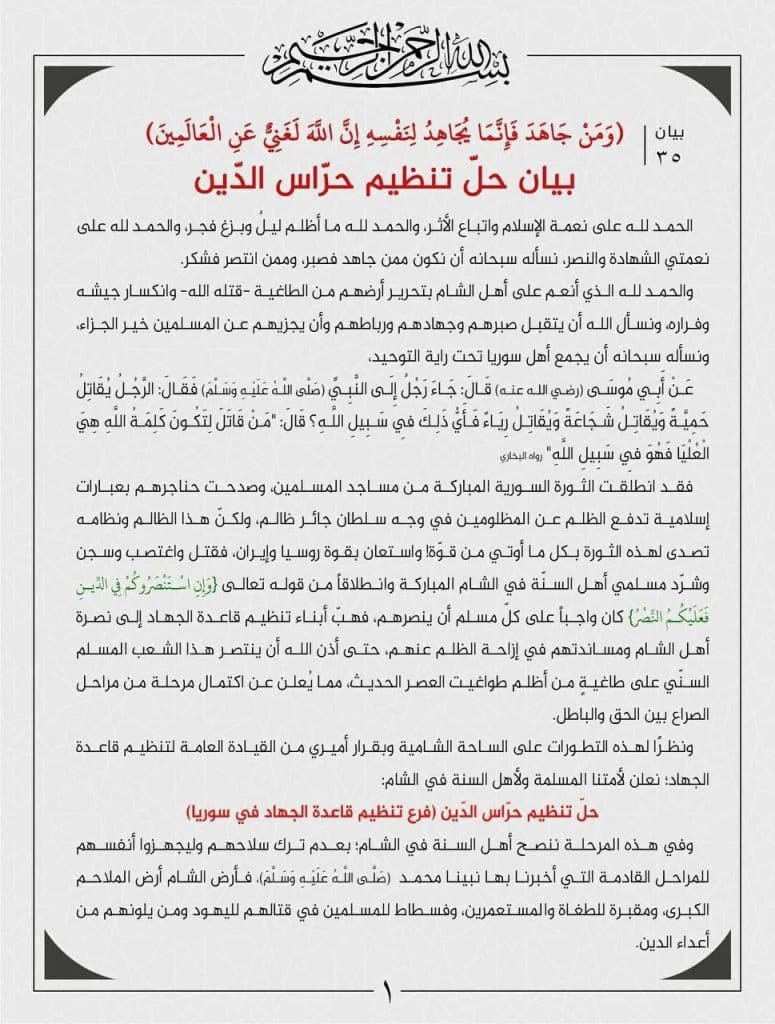
Statement by Huras al-Din
The Huras al-Din group has been active as part of al-Qaeda (AQ) since 2018 and comprises elements of the previously AQ-affiliated al-Nusra Front which broke from AQ in 2016. The group has since consisted of several minor factions, including Jaysh al-Malahim Coastal Army, Desert Army, Coastal Units, Kabul Unit, Soldiers of Sharia, and Soldiers of al-Aqsa, who all have ideological ties with AQ. In recent years, the group’s influence declined significantly as a result of an effective leadership decapitation campaign by the International Coalition as well as pressure from the HTS, which successfully outmaneuvered attempts by extremist Islamist elements to organize themselves.
DAMASCUS & THE SOUTHERN REGION (including Suwaida, Daraa & Quneitra)
Reports of VBIED detonation in Damascus dismissed as false reporting
Early on 30 January, a single social media source reported a VBIED (vehicle-borne improvised explosive device) detonation in the Assad neighborhood of Damascus City. A still picture, allegedly depicting the explosion, was also published and subsequently disseminated by several accounts on social media platforms such as Facebook and X. More credible sources did not report the attack and no officials or security members have discussed the incident. A closed source later denied the veracity of the claim and said no attacks were recorded in the capital during the day. The report is therefore confidently assessed as fabricated and likely disseminated as part of a deliberate misinformation campaign, plausibly conducted by actors with the intent to undermine the current government and perceived security situation in Damascus.
Conflicting reports of shooting near Russian Embassy
In another noteworthy incident, media sources reported a shooting incident near the Russian embassy in Damascus. Conflicting accounts emerged between security services and eyewitnesses. According to an embassy guard, the incident resulted from Public Security Services pursuing a group of regime remnants traveling in a vehicle. However, eyewitnesses separately reported that four gunmen dressed in black exited a Kia Sportage on Adawi Highway and opened fire on another vehicle traveling in the opposite direction toward Abbassiyyin Square. Regardless, the incident does not appear to have been directed against the Russian embassy or to have involved a political motive. The timing however is noteworthy shortly after a high-level Russian delegation visit earlier this week.
Other hostilities in the city were limited to low-level violence. On 29 January, a young man was found murdered inside his home in the Harasta suburb of Damascus City. The perpetrators remain unidentified. The victim was originally from Istabraq village in the Idlib countryside.
Celebratory fire in Damascus following ‘Victory’ conference
On the evening of 29 January, celebrations, shootings, and fireworks were reported in Damascus City, including Umayyad Square, following the above-described Victory Conference and the appointment of Ahmed al-Sharaa as President of Syria. Heavy gunfire was heard in Rukn al-Din, Mazra’a, Arnous, Maysat, and Thawra Street as a result. Celebratory events and gunfire were also reported in other cities of the country following the announcement, underscoring the importance of exercising caution in connection with major announcements, sports events, weddings and religious festivities that may elicit similar reactions.
Israeli forces enter western Daraa countryside
According to multiple reports early on 30 January, Israeli forces advanced into the so-called Yarmouk Basin in the western countryside of Daraa province. The force established a presence in the Abidin military post, near the towns of Abidin and Jamla, while a convoy consisting of six vehicles entered and temporarily patrolled the city of Jamla. Israeli fighter jets also circulated the area prior and during the operation. Residents were told to stay indoors and a curfew was imposed, with no movement reported in the city during the morning of 30 January.
Of note, the incursion follows a statement by the Israeli Defence Minister Israel Katz who, on 28 January, said Israel’s presence in Syrian border areas will be “permanent”. In response, the Syrian government and several regional actors, including Qatar and Turkey, have called for the issue to be raised within the UN.
Attempted assassination of former regime-linked individual in Daraa
Hostilities in the Daraa and Suwayda provinces were linked to diverse threat conditions. On the evening of 29 January, local sources reported that Walid Taha Al-Shatar, a local group leader, was targeted by gunfire in Sanamayn City, northern Daraa province. He sustained serious injuries as a result but survived the apparent assassination attempt. Al-Shatar has been targeted multiple times before and was affiliated with Mohsen Al-Haimed, who was connected to the Military Security Branch of the dissolved Syrian regime. The incident is thus consistent with a pattern of revenge action against former regime individuals.
Separately, on the evening of 29 January, social media sources reported that an armed group of unknown affiliation entered the village of Tabna near Sanamayn City, Daraa province. The group reportedly opened fire during a failed armed robbery attempt before withdrawing from the village.
NORTH & EAST SYRIA (Including Hasaka, Deir Ez Zour, Aleppo & Raqqa provinces)
Turkish airstrikes continue in eastern and northern Aleppo
Turkish airstrike activity in eastern Aleppo remains intense, with multiple operations reported on 29 January. This included airstrikes in Kobani city and just south of it, killing at least two and wounding others. The SDF claimed – questionably – that 12 civilians were killed as a result of an airstrike against a market in Sarrin city, however this was not confidently verified and the casualty figure was most likely exaggerated. Further south, airstrikes and artillery fire were also reported near the Tishreen Dam. According to the Syrian Observatory for Human Rights (SOHR), this included a strike against a gathering of civilians near the dam, however no casualties were discussed.
For their part, the SDF reportedly targeted Turkish positions in Zarkan as well as SNA-operated artillery assets northeast of Manbij, along the western bank of the Euphrates River. This comes in response to assessed Turkish shelling of SDF positions on the eastern bank, with this activity consistent with tit-for-tat frontline exchanges across the river.
Separately, the SDF denied claims by the Turkish Ministry of Defense that 14 SDF fighters were killed in North and East Syria on 28 January. To recall, intense operations were reported that day and a subsequent statement by the Turkish MoD was released with the stated casualty figure. As usual, the veracity of these claims and counterclaims remains difficult to verify given the politicized nature of these reports and conflicting propaganda claims by both sides.
Hostilities between SDF and SNA continued in Hasaka province
Hostilities involving Turkish-backed SNA and the SDF also continued in the Hasakah province. On 30 January, SDF-linked media reported that Turkish army artillery bombed the silos of Umm al-Keif and Kozliya villages along the M4 international road in the Tal Tamr district, Hasaka province. No immediate results were specified. This followed similar operations recorded the day before when the SDF reportedly shelled a Turkish army base in the Bab al-Faraj area, northwestern Hasaka province, with an anti-tank guided missile (ATGM), killing a Turkish officer and destroying a radar system. Two other Turkish officers were wounded and transported to Turkish territory for medical treatment.
On the same day, Turkish forces and SNA factions shelled the villages of Gharbi and Jdeidet Mirzo with heavy artillery and also targeted the road between Tal Tamr and Abu Rasin town in northern Hasaka province. The bombardment caused material damage to civilian homes and the road, but no casualties.
Security operations and remnant explosions in Deir Ez Zour
In a continuation of previous activity, the SDF conducted additional security operations in Deir Ez Zour province, targeting tribal elements affiliated with Sheik al-Hafl. At least four individuals were arrested as a result of operations on 29 January in the Muhaimidah town.
Explosions caused by remnant devices in desert areas of the province were also reported. On 29 January, the SOHR reported that a young man was killed by a landmine explosion while grazing sheep in the Ashara desert. Elsewhere, a child sustained serious injuries when a bomb detonator exploded near a garage in Mayadeen City.
CENTRAL REGION (Including Idlib, Hama, Latakia, Tartous, Hama & Homs)
Threats of retaliatory events in Homs province
No further incidents or violence linked to retaliatory or sectarian tensions were reported over the review period in Homs or Hama provinces. That said, on 29 January, social media sources reported that armed groups from the villages of Houla and Zaafarana imposed large levies on the residents of Kafrnan village in Homs countryside. They demanded over one billion Syrian pounds as “blood money” for past events, threatening displacement and property confiscation if payments were not made by Friday. The armed groups warned that they would forcibly enter the village and seize homes and property if their demands were not met.
Separately, in Homs City, local sources reported that an HTS member detonated a hand grenade on Hadara Street in Homs City as a celebratory act following Ahmed al-Sharaa’s appointment as president.
Grenade attack and security operation reported in Latakia and Idlib
Activity in the Latakia and Idlib provinces was limited overall. On the evening of 29 January, social media sources reported that an individual threw a hand grenade at an undisclosed location in Latakia City. The explosion caused only material damage and is assessed to be related to a local dispute.
Separately, in Idlib province, the HTS launched a security campaign, arresting former regime members who had fled there after the fall of the regime. HTS stated that the operation was limited to arresting wanted individuals without armed clashes and that their weapons were seized.

 and then