
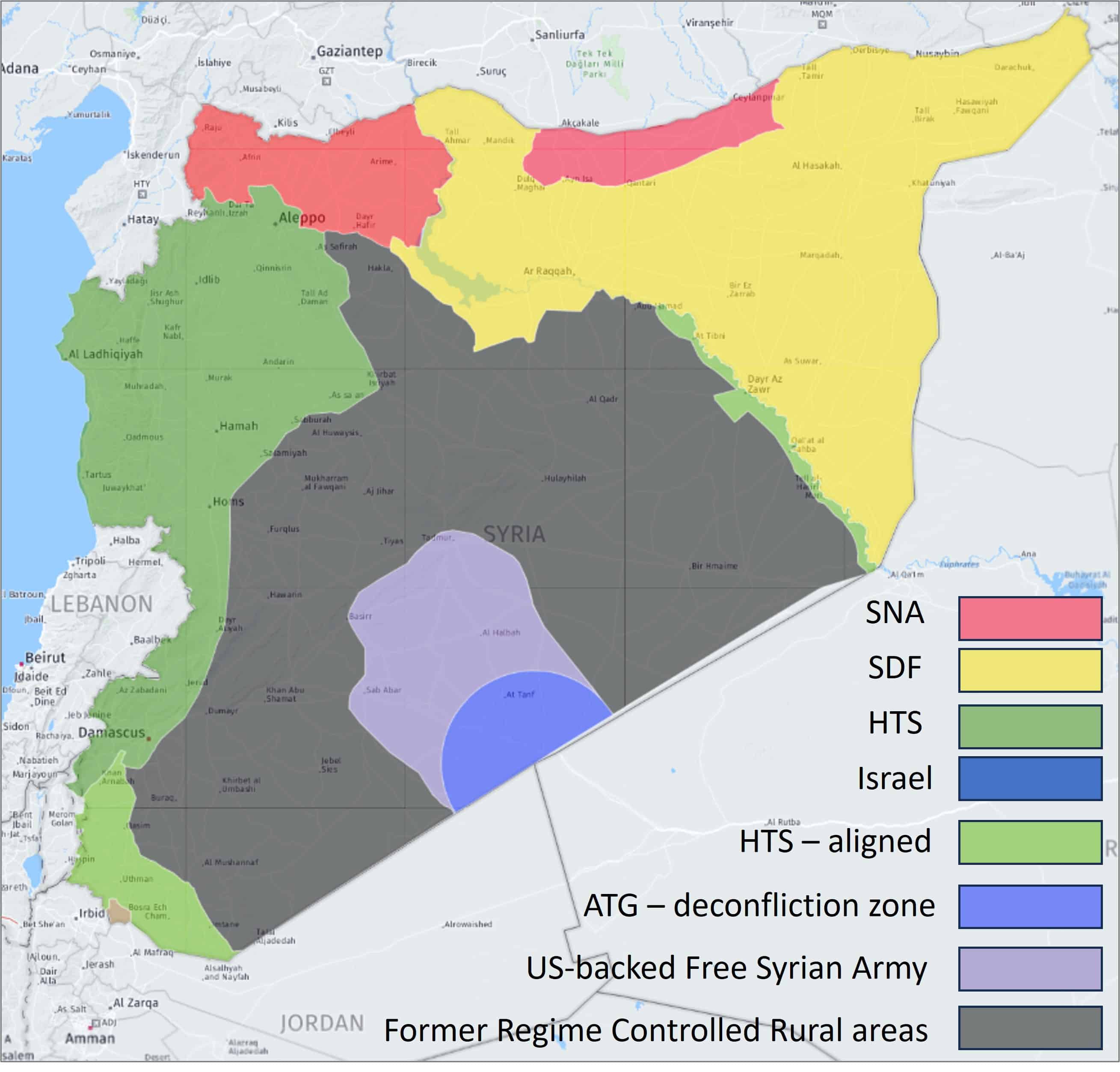
NATIONAL OVERVIEW
Dear subscriber. Welcome to the Syria Daily Report – a brand-new reporting service launched by Talos that will provide in-depth, high-quality reporting of tactical, strategic and political developments in Syria. The report will cover all provinces of Syria and be complemented by a weekly report, to be disseminated every Monday. The service will be provided for our existing subscribers for free for a limited time period and then offered as a separate, stand-alone product outside your regular subscription. For inquiries regarding prices for a subscription, or the availability of bespoke reporting on Syria – including in-depth reports, risk assessments and incident data – please email [email protected]. Please also contact us if you are interested in transportation or other security services in Syria. In the meantime, please enjoy this complimentary service.
Nationwide incidents
SIGNIFICANT EVENTS
- Russian foreign minister says Russia has not left the country
- US reiterates partnership with SDF in fight against IS
- Arab League delegation to visit Syria
- Tensions reported in Christian area of Damascus city
- Clashes and armed attack involving SDF
- SNA attacks continue near Tishrin Dam
- Clashes between HTS and resistance groups in Latakia
- Clashes between Lebanese Hezbollah and HTS near border
- Multiple incidents linked to section tensions in Homs and Latakia
STRATEGIC AND POLITICAL DEVELOPMENTS
Russian foreign minister says Russia has not left the country
In a press conference on 14 January, Russia’s Foreign Minister Sergei Lavrov addressed the situation in Syria and made several remarks that seemed intended to distance the Russian government from the regime led by President Bashar al-Assad. Notably, Lavrov attributed the fall of the government and the deteriorating security situation to the previous government’s unwillingness to implement reforms and further an inclusive political process: “The refusal of the former Syrian regime to make any changes or share power with the opposition was one of the primary reasons for its collapse,” he said. Lavrov also criticized the regime for its reluctance to “move forward politically” and to favor the status quo, despite support from Russia and Arab nations.
Regarding the current situation, Lavrov pushed back against the notion that Russia has left the country and emphasized that Russia “has not and will not leave the region”. While not commenting on the current presence and status of Russian forces in the country, the foreign minister emphasized that the Russian embassy has not left Damascus and that Moscow “maintains ongoing communication with the authorities.” Regarding the situation in the northeast, Lavrov also reiterated Russia’s support for Kurdish rights within “constitutional frameworks” in Syria as well as in other regional countries with Kurdish minorities.
The remarks are clearly intended to push back against the perception of the Assad-led government’s collapse as a Russian defeat and a mark of Russia’s declining influence in the region more broadly. The remarks are also consistent with rhetoric by Russian officials that have sought to distance themselves from the Assad-led government, most notably by blaming the government for its reluctance to further the political progress and for being uninterested in pursuing a diplomatic solution to the conflict. While clearly intended as a face-saving measure for the Russian government, it should be noted that the collapse of the Assad government followed visible frustrations within the Russian leadership over the former government’s unwillingness to negotiate with the opposition and its overreliance on foreign support to sustain its hold on power.
The remarks are also intended as a gesture towards the new HTS-led government and a sign of Russian intent to engage the new leadership. Various reports in recent days indicate that a delegation of Russian representatives will visit Damascus in the near future to meet with the new government, however as of writing no date has been set and the HTS’s willingness to engage Russia remains highly uncertain. Other reports indicate Russia, while maintaining a presence at its naval bases in Tartous and Latakia, is facing logistical issues withdrawing military equipment and other assets due to new restrictions imposed by the new government on Russian ship movements.
US reiterates partnership with SDF in fight against IS
Addressing the situation in Syria in a press conference on 14 January, the White House National Security Council Spokesperson John Kirby reiterated the US commitment to its partnership with the Syrian Democratic Forces (SDF) and the joint efforts to prevent a resurgence of IS in eastern Syria. Kirby described the partnership as “really strong” and that the US wants it to “continue” to prevent IS elements from exploiting the current situation in Syria to re-emerge. Addressing the implications of this relationship on relations with Turkey, Kirby added that the US “understands that Turkey has legitimate security concerns” and that they are “in active conversations with” Turkey regarding the issue.
Further details regarding these conversations with Turkey were not provided, however this echoes sentiments expressed by US officials in recent weeks that seek to balance the need to maintain and reassure the SDF of its partnership to combat IS with the need to address and mitigate Turkish concerns. The latter has gained importance in the face of reports indicating a Turkish ground incursion into northern Syria is likely as Turkey seeks to capitalize on the government change in Damascus to dislodge the PKK/YPG in the northeast. In December, multiple sources reported an increase in Turkish troop movements and preparations for an assault on the city of Kobani, with US and SDF officials warning that a Turkish operation may take place before the inauguration of incoming President Donald Trump. So far, this has not materialized and a combination of diplomatic efforts and changing conditions on the ground seem to have mitigated the outlook for a Turkish operation before the inauguration on 20 January.
Arab League delegation to visit Syria
On 14 January, an informed source reported that a delegation from the Arab League, led by Assistant Secretary-General Ambassador Hossam Zaki, is scheduled to visit Syria for two days starting Friday 17 January. The visit aims to engage with officials from the new Syrian administration and submit a report to member states on events in Syria. Zaki stated on 6 January that appointing Ahmed al-Sharaa, the leader of the new Syrian administration, to Syria’s seat in the Arab League is possible but that it would require a decision by the member states.
DAMASCUS & THE SOUTHERN REGION (including Suwaida, Daraa & Quneitra)
Explosions reported south of Damascus City
In the early afternoon of 15 January, several explosions were heard in areas south of Damascus City with initial reports indicating the likely involvement of Israeli airstrikes. The explosions reportedly affected ammunition depots belonging to the former government, including the 55th Air Defense Battalion near the Jebel al-Manea (Mount Manea), located approximately 12km south of Damascus International Airport. The area has been subjected to Israeli airstrikes in recent months as part of a standing effort by Israel to degrade the capabilities of the Syrian army. As of writing, no casualties have been reported yet further details remain pending.
Tensions reported in Christian area of Damascus city
Hostilities in Damascus involved a mix of sectarian and localized violence, impacting the local population only. On the evening of 14 January, cars carrying armed men entered the predominantly Christian neighborhood of Al-Qassaa in Damascus City. They distributed papers urging women to wear the niqab and asked residents not to smoke. This led to a confrontation with Christian youths, escalating into a fistfight after the armed men fired shots to intimidate them. Civilians confiscated the weapons and handed the men over to the Public Security Service.
On the same day, a family dispute erupted in Hafir al-Fawqa, Eastern Qalamoun, Damascus City, involving light and medium weapons. HTS forces intervened and imposed a temporary curfew while arresting several individuals involved. Local sources indicated that there were fatalities as a result of the gunfight however the exact number remains unclear.
Protests linked to employment and accountability issues
Protests in the capital city were linked to localized issues – all unfolding peacefully and without incident. On 14 January, dozens of Real Estate Bank employees protested outside the bank against their dismissal by the new Syrian administration. The demonstrators demanded explanations and accountability for the decision. Separately, dozens of people demonstrated in Umayyad Square in central Damascus City, demanding accountability for those involved in the former Syrian regime’s use of chemical weapons against Syrians. Footage from the location depicted a small gathering of individuals holding the new Syrian flag and with no security forces present.
Grenade and shooting attack reported in Suwayda province
Violence in Suwayda included smaller incidents linked to assessed local disputes. On 15 January, an unidentified man died and another was injured when a hand grenade detonated under unclear circumstances in Taybeh village. The victim killed was reportedly not a resident of the village yet it is unclear if he or the injured person was the target.
Separately, on 14 January, unknown assailants on a motorcycle shot a 30-year-old man near the National Museum in As Suwayda City. The victim, who worked in the car trade, was killed. The motive for the attack remains unknown but such incidents are characteristic of personal or local disputes.
NORTH & EAST SYRIA (Including Hasaka, Deir Ez Zour, Aleppo & Raqqa provinces)
Clashes and armed attack involving SDF
On the evening of 14 January, heavy clashes erupted in the Ramila neighborhood of Raqqa City between the SDF and wanted individuals from the Hafez family. The confrontation extended to the vicinity of the Silos Prison. Limited social media sources suggested the clashes were linked to an escape attempt by IS members, though this claim was denied by closed sources.
Separately, an armed group targeted an SDF oil tanker on the 7-kilo-Muhaimidah Road, western Deir Ezzor province. No casualties were reported and the identity of the assailants was not specified. The attack is indicative of IS involvement however as insurgents have been frequently targeting oil tankers and SDF-linked vehicles on the road.
SNA attacks continue near Tishrin Dam
Clashes between the Syrian National Army and the SDF continue in the vicinity of the Tishreen Dam where, on 14 January, elements of the SNA 51st Division attacked Sertil Hill. Seven National Army fighters were killed, and three SDF members were injured in the ensuing clashes. Concurrently, the SDF targeted SNA positions in Tal Arish, Al-Sukariyeh, and Abu Qalqal near the Tishrin Dam with rocket launchers, though no casualties were reported. In the same area, two SDF members were killed in a Turkish airstrike on a military point near the Qara Qozak Bridge. Turkish warplanes also conducted nine airstrikes on Sarrin Airport, Mount Barkal, and Al-Dikan village, south of Kobani, as part of a standing Turkish effort to provide air support for SNA ground operations.
In a related development, the SDF announced outcomes from operations conducted between 13 and 14 January. According to their report, 28 National Army members were killed and 36 others wounded, including 10 critically. The SDF destroyed five armored vehicles, two military vehicles, and targeted 24 National Army gatherings while shooting down a suicide drone. The statement also confirmed that four SDF members were injured during Turkish air and drone strikes near the Tishrin Dam.
On the Qara Qozak front, the SDF also targeted National Army positions near Qabr Imo and Syriatel Hill, killing five and wounding 12 others, while Turkish forces stuck multiple villages near the Qara Qozak Bridge and Kobani using heavy weapons. Turkish drones and suicide drones also reportedly targeted SDF points in the Deir Hafar front and other areas, with limited damage reported. No changes in the territorial control of terrain were confirmed as a result of these operations.
CENTRAL REGION (Including Idlib, Hama, Latakia, Tartous, Hama & Homs)
Clashes between HTS and resistance groups in Latakia
The HTS continues to experience acts of resistance within areas of its control, resulting in localized clashes reported in recent days in the Latakia and Homs provinces. On 14 January, Major Mustafa Kenefa, Director of the HTS General Security Department in Latakia, reported that two individuals were killed and several others injured during clashes between HTS and supporters of the previous regime in Ain al-Sharqiya, Jableh district, Latakia province. The clashes followed a routine patrol during which members of the group, led by Bassam Hussam al-Din, captured seven HTS members and made demands for self-rule for the Alawites and the withdrawal of foreign fighters. In response, HTS launched a security operation involving helicopters and drones, freeing the captives.
Bassam Hussam al-Din detonated hand grenades during clashes, killing himself and three others whereas HTS forces stormed the group’s location, arrested five members, and seized weapons and military equipment, including guided missiles. The Syrian Observatory for Human Rights reported that a temporary curfew was implemented in the area and that additional arrests were made, including of prominent tribal sheiks who expressed sympathy with the resistance group.
Clashes between Lebanese Hezbollah and HTS near border
The clashes follow statements released by the so-called “Syrian Popular Resistance” – a pro-Assad group that launched an armed resistance against the HTS in December – that it killed dozens of HTS members (some sources said 35 HTS members were killed) in western Homs province near the Lebanese border. The incident was not independently confirmed and the death of 35 members appears greatly exaggerated however the claim coincided with clashes involving Lebanese Hezbollah near the areas of Hermel and Qusayr. Details remain limited but local sources stated the confrontation was linked to the smuggling of weapons across the border, with the claim by the Popular Resistance assessed as a likely attempt to capitalize on the incident to gain exposure. So far, there are no credible indications that the resistance efforts launched by the “Syrian Popular Resistance” present a serious challenge to the HTS and the incidents remain isolated.
Multiple incidents linked to section tensions in Homs and Latakia
Sectarian tensions involving Alawite residents continue to be reported in the central region as well, involving both communal attacks and more organized arrest campaigns. On 14 January, the Syrian Observatory for Human Rights reported attacks on Alawite residents in Tasnin village, Homs countryside, by individuals claiming HTS affiliation. The attackers reportedly set fire to seven homes, and killed six villagers. The same sources claimed that despite attempts by residents and dignitaries to contact security, political officials, and the Homs police leadership, no response to address the violations was received.
Separately, an unidentified Islamist armed faction circulated a video in which militants declared intentions to displace Alawites from their villages and cities into camps. They called for a three-day mourning period for Public Security Service members killed in Latakia, demanded the exclusion of Alawites from government employment, and advocated for the public execution of Alawites. Later in the evening, hundreds of people demonstrated in the Saliba neighborhood of Latakia City, chanting sectarian slogans and verbally insulting the Alawite sect. Public Security forces intervened, dispersed the demonstration, and arrested several participants in a sign that the HTS will crack down on such activities amidst political and international pressure to form an inclusive government in exchange for the lifting of sanctions.
Former intelligence director targeted in security campaign
On 14 January, the Syrian Observatory for Human Rights (SOHR) reported that Public Security Forces prepared a campaign to arrest Major General Hussam Louka, the former regime’s general intelligence director, after locating his suspected hiding place in Homs City. Security forces surrounded several neighborhoods, including Inshaat, Tawzee Al-Ijbari, Baba Amr, and Jouret al-Arayes.

 and then