
Disclaimer: The information and opinions expressed in this Report are the views of Talos and constitute a judgment as at the date of the Report and are subject to change without notice. The information and opinions expressed in this Report have been formed in good faith on the basis of the best information and intelligence available at the time of writing. Vesper Group accepts no liability arising out of or in connection with the comments made or the information set out in this Report and the reader is advised that any decision taken to act or not to act in reliance on this Report is taken solely at the reader’s own risk.
For questions regarding this report or regarding a subscription, please contact us here:https://talosinformation.com/contact-us/
Executive Summary
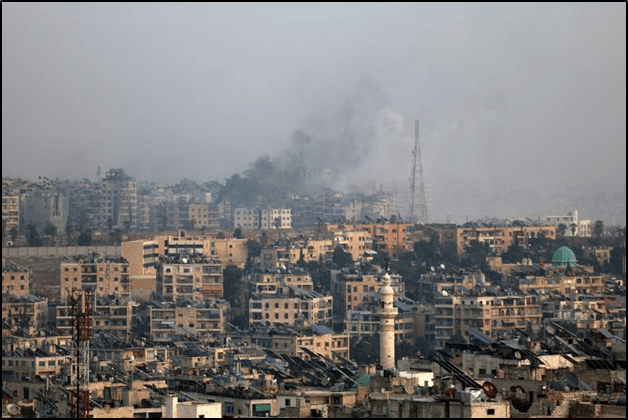
Starting Tuesday, January 7, 2026, the northern Syrian city of Aleppo became the focal point of intense military clashes between the Syrian government forces and the Kurdish-led Syrian Democratic Forces (SDF). As of Thursday evening, January 8, 2026, this represents the most severe confrontation since the fall of former President Bashar al-Assad in December 2024. The violence has resulted in at least 22 documented deaths, with casualty figures still rising, and has triggered the displacement of over 100,000 civilians from their homes. This escalation marks a critical breakdown in regional stability and threatens ongoing negotiations aimed at integrating the SDF into Syria’s national military structure.
Background: The Integration Dispute
The March 2025 Agreement
The current conflict stems from a stalled integration agreement signed in March 2025. The Syrian government, under the leadership of President Ahmed al-Sharaa, and the SDF reached an understanding to incorporate the primarily Kurdish militia into the national state framework and Syria’s unified military structure. This agreement was designed to preserve Syria’s territorial unity and prevent the establishment of a de facto autonomous Kurdish region within the nation.
Stalled Implementation
Despite the agreement’s signing, implementation has progressed slowly over the past nine months. Both the Damascus government and the SDF have accused each other of failing to meet the terms and timelines established in the March accord. International mediation efforts, including discussions led by the United States as recently as January 5, 2026, have failed to produce concrete results or renewed momentum toward integration.
The SDF, which has controlled significant portions of northeastern Syria and parts of Aleppo since establishing a semi-autonomous administration during Syria’s 14-year civil conflict, has resisted full centralization of command and control to Damascus. The government, meanwhile, has expressed frustration with what it characterizes as the SDF’s foot-dragging and reluctance to surrender autonomy.
Timeline of the January 2026 Escalation
Tuesday, January 7 – Violence Erupts
The violence commenced on Tuesday, January 7, 2026, beginning near the Alleramoon roundabout on Aleppo’s western outskirts. Initial clashes between government forces and the SDF rapidly spread to the predominantly Kurdish neighborhoods of Ash-Sheikh Maqsoud and Ashrafiyeh, which have remained under significant SDF control. Early exchanges of gunfire and artillery fire resulted in civilian casualties and prompted initial displacement of residents.
Wednesday, January 8 – Fighting Intensifies
By Wednesday afternoon, the Syrian military escalated its operations dramatically. The army initiated concentrated artillery bombardments targeting SDF positions in Sheikh Maqsoud and Ashrafiyeh. The military announced that these areas would be classified as “closed military zones,” and residents were ordered to evacuate. Authorities reported the use of medium and heavy weapons, along with drone strikes, marking a significant increase in intensity from the first day of fighting.
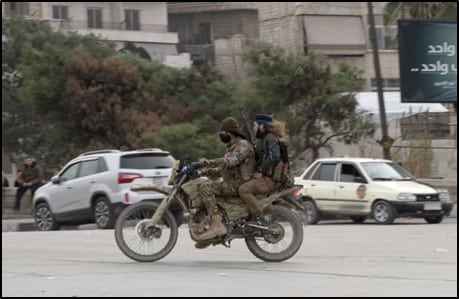
The government announced a curfew in Ashrafiyeh and Sheikh Maqsoud, citing concerns about SDF assaults on government-controlled areas. Simultaneously, the SDF launched retaliatory artillery and mortar fire targeting the al-Midan district and other government-controlled neighborhoods.
Health officials reported mounting casualties, with at least four civilians killed in government-held areas by Wednesday. The SDF claimed that seven civilians perished in the neighborhoods under its control. These figures proved to be preliminary, as violence continued to escalate through Thursday.
Thursday, January 8 – Third Day of Clashes
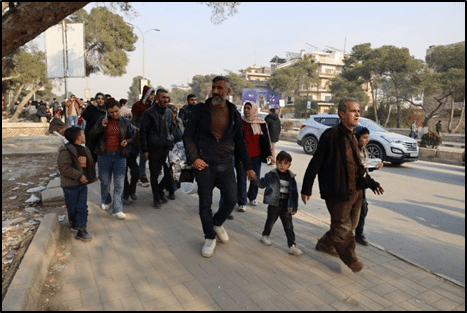
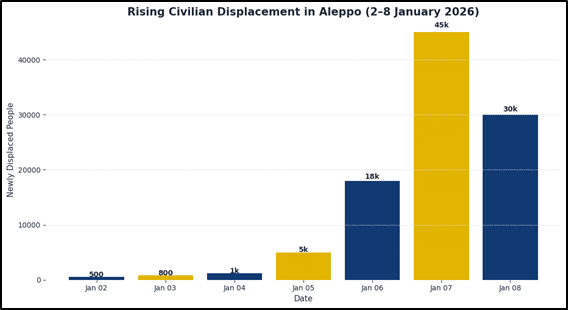
On Thursday evening, January 8, fighting entered its third day with no signs of abating. The Syrian military released over seven detailed maps pinpointing target locations in Maqsoud and Ashrafiyeh neighborhoods, announcing planned strikes beginning at 3 p.m. local time and urging residents to evacuate immediately. Civil defense officials reported that nearly 13,500 individuals had fled during the day, with the majority being women, children, and individuals with special needs.
The Syrian Ministry of Interior announced that government forces had commenced deployment in the Ashrafiyeh area, claiming that “armed groups associated with the SDF” had withdrawn. The ministry stated that units were initiating security operations “to safeguard civilians and prevent violations or signs of chaos, in coordination with Army units stationed in the neighborhood.” However, heavy artillery fire continued to thunder through the city, with correspondents reporting sounds of continuous shelling even from within hospital facilities where wounded were being treated.
Casualty Figures and Human Impact
Documented Deaths
Casualty figures remain contested by both sides, with each accusing the other of inflicting civilian deaths. As of January 8, 2026:
| Reported Deaths | Government-Controlled Areas | SDF-Controlled Areas |
| Initial Reports (Wednesday) | 4-5 | 7 |
| Updated Figures (Thursday) | 9-12 | 10-12 |
| Official Toll (As of Thursday Eve) | At least 22 total (figures combined) |
Casualty figures by location, January 7-8, 2026
The New York Times reported that health officials in Aleppo confirmed at least four civilians killed in government-held areas by Wednesday, with an additional soldier killed according to SANA, the Syrian state news agency. The SDF claimed higher figures in their controlled neighborhoods but provided no casualty figures for their armed fighters.
Injuries and Medical Strain
Health officials reported at least 173 individuals injured as of Thursday evening. These figures include both civilian and military casualties. Hospital staff worked under extremely challenging conditions, treating incoming patients while the sounds of heavy shelling continued in the immediate vicinity. Medical facilities reported difficulty accessing supplies and staff due to the security situation.
Massive Civilian Displacement
The humanitarian impact of the violence extended far beyond casualty counts:
- Over 100,000 civilians fled their homes in Ashrafiyeh and Maqsoud neighborhoods
- Approximately 13,500 individuals evacuated on Thursday alone
- Over 2,000 refugees relocated to Afrin, a nearby region
- 1,100 individuals sheltered across nine collective centers
- Additional thousands scattered to unknown locations or remained in hiding
Rana Issa, a 43-year-old mother, described the harrowing escape from Ashrafiyeh to international media: “Many people want to leave, but fear the risk of being shot. We’ve endured very challenging times. My children were terrified.” Her account captured the desperation of hundreds of thousands attempting to flee danger while dodging sniper fire.
Military Operations and Tactical Developments
Government Forces Strategy
The Syrian military adopted an aggressive approach, utilizing concentrated artillery strikes, aerial bombardment capabilities including drones, and ground troop deployments. Military sources indicated that the focus centered on targeting SDF positions in Sheikh Maqsoud and Ashrafiyeh—neighborhoods with significant Kurdish populations and SDF military infrastructure.
The decision to declare these neighborhoods “closed military zones” effectively authorized unrestricted military operations, eliminating the theoretical protection of civilian areas under international humanitarian law. The announcement of specific strike maps, while potentially intended to allow civilian evacuation, also signaled a deliberate and methodical plan to eliminate SDF presence in these neighborhoods.
SDF Response
The SDF, described as a US-supported coalition that has served as the primary American ally against ISIS in Syria, responded with artillery and mortar fire targeting government-controlled neighborhoods, particularly the al-Midan district. SDF commanders denied government claims that they were using civilian areas as military bases, instead asserting that the government was conducting “indiscriminate” shelling that deliberately targeted civilian populations.
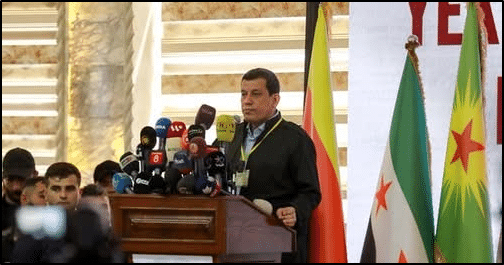
SDF commander Mazloum Abdi (also known as Mazloum Kobani) characterized the violence as a war crime, stating that the government’s actions “undermine the prospects for reaching agreements” on integration. He emphasized that “the presence of tanks and artillery in Aleppo neighborhoods, the bombing, displacement of civilians, and attempts to invade Kurdish neighborhoods during the negotiation process” represented violations of commitments made in the March 2025 agreement.
International Response
The United States, which has maintained a military presence in northeastern Syria and supports the SDF as a counter-ISIS force, attempted to mediate the dispute. Talks concluded without productive results, leaving the international community in a reactive posture.
Israel condemned the violence, with Israeli Foreign Minister Gideon Sa’ar characterizing the government’s actions as attacks on the “Kurdish minority” and suggesting that the violence could constitute “ethnic cleansing.” Sa’ar warned that unless the international community took action, “the violence in Aleppo could increase”.
The Prime Minister of the Kurdistan Regional Government in Iraq, Masrour Barzani, also expressed grave concern, calling for all parties to exercise restraint and engage in dialogue while safeguarding civilians.
Infrastructure Damage and Service Disruptions
The escalation severely damaged Aleppo’s infrastructure and disrupted essential services:
- Aleppo International Airport: All commercial flights were suspended starting January 6, with rerouting of passengers to Damascus International Airport
- Power Outages: Significant portions of Aleppo experienced electricity disruptions, complicating medical treatment and evacuation efforts
- Water Supply: Water services were disrupted in affected neighborhoods, creating humanitarian challenges
- Telecommunications: Communication networks suffered partial outages in affected areas
- Road Closures: Vital roads were closed to facilitate military movements, restricting civilian access to hospitals and safe zones
- Educational Facilities: Schools were closed throughout the city
- Government Services: Most government facilities shuttered their operations
These infrastructure failures compounded the humanitarian crisis, as residents struggled to access medical care, communicate with family members, and locate safe shelter.
Conflicting Accounts and Blame
Government Position
The Syrian government and military, through SANA and official statements, accused the SDF of initiating the violence and of utilizing civilian areas in Sheikh Maqsoud and Ashrafiyeh as military bases from which to launch attacks. Government sources claimed that SDF shelling deliberately targeted civilian neighborhoods in government-controlled areas, intentionally maximizing civilian casualties to create international pressure.
The government framed its military operations as a necessary response to SDF aggression and as a critical step toward reasserting Syrian sovereignty over all territory, including the historically significant city of Aleppo.
SDF Position
The SDF denied initiating the conflict and asserted that the government’s military operations constituted a premeditated assault on civilian Kurdish neighborhoods. The SDF accused factions allied with Damascus of threatening unlawful strikes on civilian zones and suggested that government announcements of impending shelling, rather than allowing humanitarian evacuation, were designed to force displacement and constitute war crimes under international humanitarian law.
The SDF emphasized that the government’s actions violated the spirit and letter of the March 2025 integration agreement and demonstrated Damascus’s unwillingness to negotiate in good faith.
Strategic Implications
Threat to Syria’s Territorial Stability
The violence in Aleppo represents the most serious threat to Syrian territorial stability since the fall of the Assad regime. The clashes underscore the fragility of any political settlement that fails to address fundamental questions about Kurdish autonomy, territorial control, and military integration.
Implications for the Integration Agreement
The March 2025 agreement now appears functionally dead, at least in the short term. The breakdown of negotiations and the resumption of large-scale violence suggest that both sides have abandoned hopes for peaceful integration and have reverted to military competition for control of key territories.
Risk of Broader Conflict
Security analysts express concern that the Aleppo violence could serve as a catalyst for broader regional conflict. Kurdish populations in other Syrian regions might mobilize in response to perceived attacks on their coreligionists in Aleppo. Conversely, Arab nationalist elements within the Damascus government could exploit anti-Kurdish sentiment to consolidate power.
International Dimensions
The violence also raises questions about international involvement. The United States maintains military forces in SDF-controlled territory and has supported the group as the primary counter-ISIS force in the region. Any escalation that threatens SDF survival could provoke direct American military intervention, potentially widening the conflict to include Turkish and regional actors.
Humanitarian Crisis
Scale of Displacement
The displacement of over 100,000 people in the span of 48 hours represents one of Syria’s worst humanitarian crises in recent years. Collective shelters established in Afrin and other safe zones quickly became overwhelmed. The majority of displaced persons were women, children, and individuals with special needs—the most vulnerable populations.
Civil defense officials reported that some patients from medical facilities were transported to hospitals in safer regions via ambulances, while others received emergency medical assistance at evacuation points.
Long-term Humanitarian Concerns
International humanitarian organizations warned of impending crises if the violence continued:
- Food Security: Disruption of supply chains threatens food supplies for affected populations and displaced persons
- Healthcare Access: Hospital closures and staff displacement reduce access to essential medical services for both combatants and civilians
- Shelter Crisis: Hundreds of thousands require immediate shelter, with insufficient capacity in current facilities
- Educational Disruption: School closures affect hundreds of thousands of students, with no clear timeline for reopening
- Water and Sanitation: Water outages create public health risks, particularly for children and the elderly
- PTSD and Mental Health: The psychological trauma of displacement and combat exposure will require long-term intervention
The United Nations Office for the Coordination of Humanitarian Affairs (OCHA) began mobilizing resources to address the emerging humanitarian emergency.
Conclusion
The violence in Aleppo from January 7-8, 2026, represents a critical inflection point in Syria’s post-Assad transition. The collapse of the March 2025 integration agreement, the resumption of large-scale military clashes, and the resulting humanitarian catastrophe demonstrate the fundamental challenges facing Syria’s attempts at national reconciliation.
The displacement of over 100,000 civilians, the documented deaths of at least 22 individuals, and the injury of 173 others underscore the human cost of this political failure. The breakdown of negotiations between the Damascus government and the SDF suggests that peaceful integration is no longer an attainable goal in the near term, and that further military confrontations are probable.
Without immediate international mediation, de-escalation mechanisms, and humanitarian intervention, Aleppo faces continued violence with potentially catastrophic consequences for Syria’s entire civilian population. The international community—including the United States, Turkey, the European Union, and regional powers—must rapidly engage all parties to prevent further escalation and facilitate protection for non-combatants.
The situation remains fluid, with reports continuing to emerge as of Thursday evening, January 8, 2026. Additional escalations or peace initiatives may alter the trajectory in coming days, but the fundamental questions about Syrian territorial unity, Kurdish autonomy, and military integration remain unresolved and increasingly urgent.

 and then