
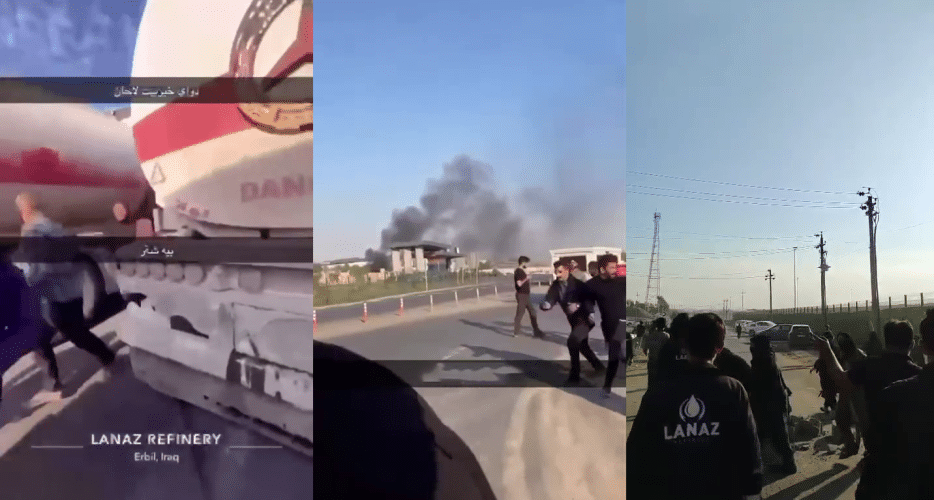
Tensions in and around Lajan village in western and southern Erbil province escalated sharply between 27 November and 1 December, beginning with localized protests over employment grievances and culminating in armed clashes, casualties, and a large-scale security crackdown involving cordons, arrests, and reported internet disruptions.
The protesters, local tribal groups, and the authorities have presented competing narratives regarding the origins of the demonstrations, and tensions in the district remained elevated as of 1 December. The risk of further hostilities remains a persistent concern. Notably, the tribe has threatened to target the nearby oil refinery and local power station if security forces are not withdrawn.
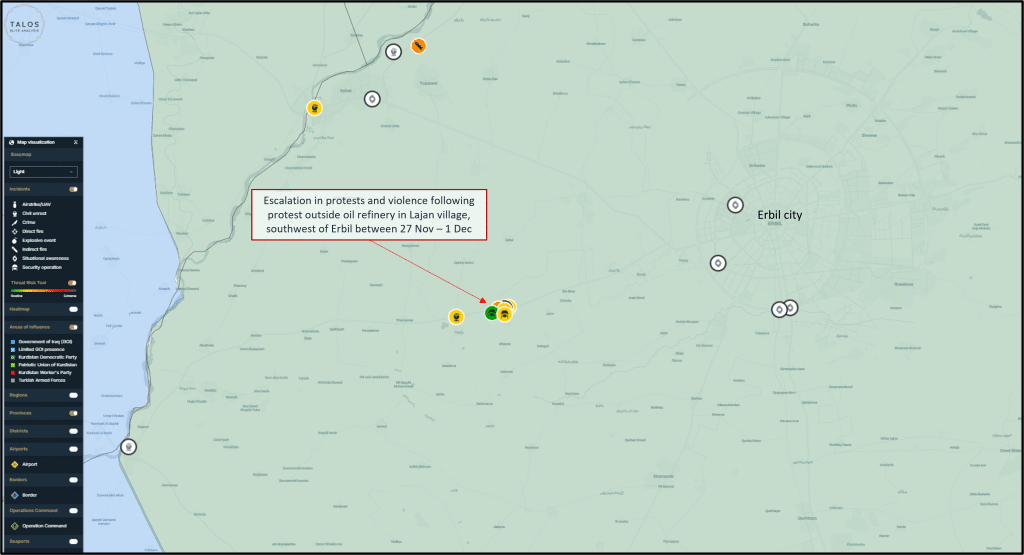
Unrest first emerged on the evening of 27 November when residents from Lajan and the neighboring Tarjan village blocked the Erbil–Mosul Highway and burned tires to demand employment with locally operating companies. Demonstrators said they had been promised jobs at the Lanaz Oil Company in exchange for supporting the Kurdistan Democratic Party (KDP) and accused the company of failing to honor those commitments. Their protest halted multiple oil tankers, marking early signs of friction near one of the region’s key industrial sites.
Violence escalated dramatically on the afternoon of 29 November. Armed confrontations broke out between members of the Hakri (Harki) tribe and Peshmerga forces roughly 300 meters from the Lanaz Oil Refinery. Shortly thereafter, a deadly confrontation occurred outside the refinery entrance on the Erbil–Gwer Highway. Local accounts reported that security personnel opened fire on protesters, killing one person and wounding several others. Tribal members subsequently closed the Erbil–Gwer Road, and unverified reports suggested that tribal gunmen and security forces exchanged fire near the protest site. The unrest continued for nearly two hours, with gunfire, ambulance movements, and additional security deployments indicating a rapidly deteriorating environment.
According to local sources, journalists were also targeted. A female correspondent was reportedly assaulted by Zervani forces while reporting in Lajan, and her equipment was destroyed. Other media crews said their cameras were damaged and memory cards seized.
By the evening of 29 November, Peshmerga units had deployed armored vehicles around Lajan in an effort to contain the unrest, reflecting concerns that the situation could escalate further. The violence appeared to be linked not only to unfulfilled employment guarantees but also to broader frustrations over service provision and unmet infrastructure commitments.
Tensions persisted on 30 November and 1 December. Late on 30 November, a large security force entered Lajan, sealed off access roads, and launched a targeted arrest campaign. Footage circulating locally appeared to show gunfire during the operation. Residents reported that security personnel damaged a truck, attempted to detain protesters inside their homes, and were instructed to apprehend roughly 30 individuals believed to have participated in earlier unrest. UAV activity was also reported overhead during the nighttime operation.
Shortly after midnight on 1 December, internet connectivity was reportedly disrupted across Lajan and neighbouring districts—including Khabat, Bardarash, and Gwer—amid claims that authorities intentionally jammed networks to support the security operation. By the afternoon of 1 December, protesters continued to block roads with burning tires, with footage showing masked individuals setting objects alight on the main road.
Ministry of Interior Blames External Actors for Unrest
Official statements have diverged sharply from the accounts provided by local tribesmen. While protesters and members of the Harki tribe maintained that the demonstrations were motivated by broken employment promises, the KRG Ministry of Interior issued a statement alleging that both internal and external actors were attempting to destabilize the region. The ministry described the unrest in Lajan and along the Gwer corridor as part of a broader campaign of disruption, beginning with the recent attack on the Khor Mor gas field.
The ministry stated that after the region shifted to liquid fuel to offset reduced gas supplies, a group of armed individuals blocked tanker routes and opened fire on civilians, killing one person and injuring several others. It vowed that those responsible would be prosecuted under applicable laws and emphasized that no individual or group was above the law.
Further details were not provided, but the ministry’s framing implicitly suggested coordination between protesters and pro-Iranian factions widely suspected of involvement in the Khor Mor attack. As of writing, Talos cannot corroborate this narrative, which may also reflect efforts to redirect attention away from unverified claims of vote-for-employment corruption raised by residents.
The unrest has drawn attention from human rights organizations. On 30 November, the Independent Human Rights Commission in the Kurdistan Region (IHRCKR) announced it had opened an inquiry into the events. It met with the Erbil governor’s office and internal security directorate and confirmed that investigators were gathering evidence to identify those responsible for the fatal shooting on 29 November.
The father of the deceased, Irfan Barzanji, stated publicly that his son—a truck driver transporting goods between Kirkuk and Erbil—was caught in the gunfire while attempting to flee the chaos. He appealed to the KRG to ensure accountability and justice.
The commission stressed that those responsible must be brought to trial and reaffirmed its support for citizens’ rights to peaceful assembly. It urged all parties to act within lawful and nonviolent frameworks.
Harki Tribe Threatens Escalation as Tensions Remain High
Amid the ongoing confrontation, the Harki tribe announced that its members had taken up arms in response to what it described as the forced displacement of Lajan residents. In a statement addressed to the international community, human rights organizations, and the federal government, the tribe drew comparisons to the Anfal-era campaigns, warned against demographic change, and called for an urgent investigation under international supervision. While asserting its commitment to non-discrimination and the rule of law, the tribe rejected what it viewed as actions undermining its rights.
As of 1 December, tensions remained high, and the risk of additional hostilities persisted. The tribe has threatened to target the oil refinery and local power station if security forces are not withdrawn, establishing clear conditions for potential further escalation in the near term.
 and then